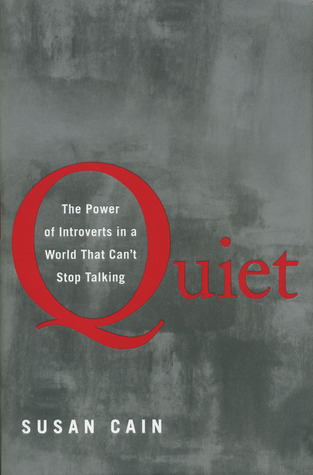
Book: Quiet the Power of the Introvert
Basic Information :
Synopsis :
Thoughts :
Evaluation :
Book Group :
New Words :
Book References :
Good Quotes :
Table of Contents :
References
Basic Information:
Author: Susan Cain
Edition:eBook on the Nook
Read:February 9, 2017
288 pages
Genre: Psychology
Rated: 3 1/2 out of 5
Synopsis:
Obviously this is a book about introverts. Cain wanders through what is an introvert. Then how our Western culture became infatuated with being more outgoing. Style becoming more of a priority than the substance of what is being projected. Cain shows how this puts the introverts at a disadvantage. There is a side excursion about how group think has been drugged into this. The emphasis being spontaneous input rather than arriving to a correct solutions. This puts the introvert at a disadvantage.
Cain looks at how an introvert becomes an introvert. Followed by, how can an introvert survive in an extrovert world?
There are sections on how societies which is more known for its quietness functions. Also about their adjustments they make to live in the United States. This is followed by tidbits on how to work out arrangements with spouses who have opposite personalities as well as nurturing quiet children.
Thoughts:
INTRODUCTION: The North and South of Temperament
What does it mean to be quiet and have fortitude? Can goes on and says this implies shy and courageous? I often have a Mel Gibson image of a person with resistance. But the bulk of people go about their lives quietly. The quest is do I go about my quiet life with integrity? Integrity to what? To myself. But that just begs, who am I? Are my ideas ones which are worth making a stand for?
Our lives are shaped as profoundly by personality as by gender or race. I think Cain is defining almost exclusively in terms being an introvert or extrovert. What I am wondering is how true is this statement. Also how does it affect us? Later in the book, she does talk about some of the effects of being an introvert.
Archetypical extrovert prefers action to contemplation, risk-taking to heed taking, certainty to doubt. This contrasts with a statement later on introversion-along with its cousins sensitivity, seriousness, and shyness-is now a second class personality trait...
Introverts living under the Extrovert Ideal are like women in a man's world, discounted because of a trait that goes to the core of who they are. First, notice the attributes given for both. How is this supported? Cain makes these assertions, setting your mind to accept what she has to say latter on. While I think they are pretty much true, the question is how did she come about to say these things?
Description of introverts:
- Introverts often work more slowly and deliberately. They like to focus on one task at a time and can have mighty powers of concentration.
- Introverts, in contrast, may have strong social skills
Nor are introverts necessarily shy. Shyness is the fear of social disapproval or humiliation, while introversion is a preference for environments that are not overstimulating. Interesting. Can you have a shy extrovert? Hard to imagine.
1. THE RISE OF THE “MIGHTY LIKEABLE FELLOW”: How Extroversion Became the Cultural Ideal
Every American was to become a performing self. Don't we put on a performance in some ways when we are with someone else? Even with your spouse? This raises the question of who am I really? Am I the person who I really am when I am by myself? Or am I being real when I am with others? This is the question Bonhoeffer asks when he was in prison through his poem,
Who Am I?
“Citizens” morphed into “employees,” facing the question of how to make a good impression on
people to whom they had no civic or family ties. As we change social surroundings, do we maintain our same personhood? Or do we change?
Apparently it’s OK to be squeamish about doing a regression analysis if you’re excited about
giving speeches. I naturally get excited by such a statement since I rarely see the term regression analysis or equations in a book. Of course I loved this part of statistics. But this does get to the heart of something dear to me. Is better to have a good presentation or good content in a presentation. The answer is, it is better to have both as a good presentation is not worth the time to put it together if it is meaningless or false. On the other hand, the best content with the most striking conclusions if wrapped in a plain brown wrapper will not get too much attention. This is not an either or, but needs to be both.
All of which raises the question, how did we go from Character to Personality without realizing that we had sacrificed something meaningful along the way? This is sort of the side question. The other question which is not asked, nor answered, is, are we better off? Any change usually has a downside to it.
2. THE MYTH OF CHARISMATIC LEADERSHIP: The Culture of Personality, a Hundred Years Later
It also suggests that salesmanship governs even the most neutral interactions. She goes on and brings up the argument that all interactions have been considered on a win-loss basis. I would agree that some are and if you want to me more Machevillian then all can be viewed that way. But I do not see it that way. Some are, particularly in a work setting. If viewed that way, then we are the most miserable of creatures as we are always looking at any friendship in view of what do I get out of it and not how do WE grow as people.
We tend to think that becoming more extroverted not only makes us more successful, but also makes us better people. In some ways this is true. Extroverted people tend to broaden their range of relationships. The question then is, Is it better to have more or deeper relationships?
HBS grads likely have influenced your life in ways you’re not aware of... Not really essential to her case about who introverts are. But as she talks about the force of extroverts at Harvard, she is saying how extroverts act affects your daily lives as they are the ones who are being pushed by schools like Harvard. You couple that with the pressure everyone feels at Harvard to succeed.
...everyone knows that it’s important to be an extrovert and troublesome to be an introvert. While you get a successful model of extroverts. But you also get something which only works one way-the loud way.
I just like this picture:
The first thing I notice about the Harvard Business School campus is the way people walk. No one ambles, strolls, or lingers. They stride, full of forward momentum
The essence of the HBS education is that leaders have to act confidently and make decisions in the face of incomplete information. Which is a useful skill. The trick is to choose the right window of opportunity, realize when a window is passing you by and when you can wait for more light on a subject. But the imperative in business is to act, right or wrong. More credit is given for acting rather than reflecting.
The risk with our students is that they’re very good at getting their way. But that doesn’t mean they’re going the right way. The problem of the verbose. What is their guidance?
The more a person talks, the more other group members direct their attention to him, which means that he becomes increasingly powerful as a meeting goes on. It also helps to speak fast; we rate quick talkers. Something which I do not do.
What is the Bus to Abilene anecdote? According to
Wikipedia, it is when a group does something which everybody dos not want to do. It comes from a parable by Jerry B. Harvey.
ranks of effective CEOs turn out to be filled with introverts, including Charles Schwab; Bill Gates; Brenda Barnes, CEO of Sara Lee; and James Copeland, former CEO of Deloitte Touche Tohmatsu. Interesting that you do not need to be an extrovert to lead extroverts or a large company. How is that done? Cain is short on this.
[Darwin]
Smith [Kimberly-Clark]
replied that he never stopped trying to become qualified for the job. Cain uses this as an example that an introvert keeps looking for ways to improve. But I heard this as a manager from cycles of improvements.
We don’t need giant personalities to transform companies. We need leaders who build not their own egos but the institutions they run. With the current political situation, this quote has never been more appropriate.
The evangelical culture ties together faithfulness with extroversion Ah yes, the evangelism which says you must collar everyone and read them the four spiritual laws. But is there a place for the more quiet types? This kind of faith does not understand the mystics or the contemplative. This is followed by a talk with Adam McHugh at Rick Warren's church.
He argues that evangelism means listening as well as talking, that evangelical churches should incorporate silence and mystery into religious worship, and that they should make room for introverted leaders who might be able to demonstrate a quieter path to God. Interesting. You wonder how it would come out. My brother goes to Red Rocks Church in Denver. Lots of music, activity and good preaching. Very entertaining. But I sometimes wonder where the quiet voice comes in. Can's conclusion is that it must
be hard for introverts to feel good about themselves.
Proust called these moments of unity between writer and reader “that fruitful miracle of a communication in the midst of solitude.” It looks like Proust's original comment was more on reading Ruskin than reading in general. More specifically he thought that Ruskin may have missed the point and that reading is not necessarily a spiritual activity. This is from a book by Marcel Proust called
On Reading Ruskin, page 113
3. WHEN COLLABORATION KILLS CREATIVITY: The Rise of the New Groupthink and the Power of Working Alone
To the Homebrew crowd, computers are a tool for social justice, and he feels
the same way. No particular reason putting this in. Just was something I wanted to remember. The “he” is Woz of Apple.
not everyone aspires to be a leader in the conventional sense of the word. Sort of a bland statement. Can makes this statement when she observes a third-grader being forced into a leadership role as a school safety officer. After all, if there are only leaders, where will the followers be. But the real secret is how to follow well and be able to share your abilities and knowledge.
Cain talks about the work of Anders Ericsson. Ericsson came up with some things which differentiated experts from the common. They included:
- Serious study alone
- Ten thousand hours of Deliberate Practice to gain true expertise
- Reinforces existing cognitive mechanisms instead of improving them.
The last thing in this chapter is that
when the group is literally capable of changing our perceptions and when to stand alone is to activate primitive, powerful, and unconscious feelings of rejection, then the health of these institutions seems far more vulnerable than we think. She talks about how a collaborative effort can easily fall into the trap of listening to its most vocal person. Instead of getting many viewpoints, you get only a few of the more vocal with many people agreeing to it. Not necessarily the wisdom of the group.
PART TWO: YOUR BIOLOGY, YOUR SELF?
4. IS TEMPERAMENT DESTINY?: Nature, Nurture, and the Orchid Hypothesis
Temperament refers to inborn, biologically based behavioral and emotional patterns
that are observable in infancy and early childhood; personality is the complex brew
that emerges after cultural influence and personal experience are thrown into the
mix. Definitions for us non-psychology types.
When writers and journalists talk, they want to see a one-to-one relationship—one behavior, one cause. This is important to note as there are very few things which are one-to-one, cause and effect. Usually there is a several causes which leads to a specific result.
child’s sensitivity to novelty. The example was that a child observes a stranger who comes into the room. Cain indicates it is not the person, but the newness of the object.
5. BEYOND TEMPERAMENT: The Role of Free Will (and the Secret of Public Speaking for Introverts)
we can stretch our personalities, but only up to a point. While it is popular to say we can be what ever/whoever we want to be, Cain points out there are residual effects which limit this ability to transform us. If we try to be something which we are not, then it takes toll.
When Cain talks about free will, I think she misuses the term. It refers to the “devil made me do it”, not our being's constraints. Such as if we jump, no amount of willing ourselves will prevent us from falling.
Free will can take us far, suggests Dr. Schwartz’s research, but it cannot carry us infinitely beyond our genetic limits ... We might call this the “rubber band theory” of personality. We are like rubber bands at rest. We are elastic and can stretch ourselves, but only so much. But Cain does say as much:
Even though we can reach for the outer limits of our temperaments, it can often be better to situate ourselves squarely inside our comfort zones. Her recommendation is that when you operate outside of your comfort area, be sure to have times of respite from those times.
The word that Kagan first used to describe high-reactive people was inhibited, The term high-reactive refers to those people who reactive to new stimuli in a sharper way than others. Such as a person coming into a room who they do not expect will startle them. The amygdala area of the brain is more sensitive to these things.
let’s focus on another difference between introverts and extroverts: their preference for stimulation. There is research which indicates that extroverts enjoy a higher level of simulation than introverts. So this leads into that each personality type should understand their needs for stimulation.
high arousal levels in the brain don’t always correlate with how aroused we feel. Interesting statement. There is a disconnect between activity and emotion. Explains why we can be doing something which we enjoy but not be happy.
You can set up your work, your hobbies, and your social life so that you spend as much time inside your sweet spot as possible. This falls under managing yourself. Know who you are, what you are doing and how it is affecting you. Then adjust to provide respite or relief. Can points out that this is
harder for introverts, who have trouble projecting artificial enthusiasm.
6. “FRANKLIN WAS A POLITICIAN, BUT ELEANOR SPOKE OUT OF CONSCIENCE”: Why Cool Is Overrated
Dr Elaine Aron-pioneer in looking at the highly sensitive person.
The man who would declare that he had nothing to fear but fear itself felt a bit lost with his wife's introvert ism. That would be Elanor. Sort of makes you appreciate how she stretched her bounds to become the woman she was.
She sends me an agenda explaining that we’ll be sleeping in rooms designated for “napping, journaling, puttering, meditating, organizing, writing, and reflecting.” Cain attended a conference for introverts and this is the introduction. Sounds interesting.
She [Dr Aron]
had trouble finding the sacred in the everyday; it seemed to be there only when she withdrew from the world. I do not think Cain meant this to be a religious statement, but it brings me to both Anne Lamott and Annie Dillard and how they do find the sacred in the ordinary.
The other thing Aron found about sensitive people is that sometimes they’re highly empathic. It’s as if they have thinner boundaries separating them from other people’s emotions and from the tragedies and cruelties of the world. That sometimes is a bothersome word. It is not as you get more sensitive you get more empathic, but sometimes. Not sure what to make of it.
Griselda-a folklore where a wife is tested. Sort of an ugly tale.
There is no single best … [animal] personality,” writes Wilson, “but rather a diversity of personalities maintained by natural selection.”
“When sensitive people are in environments that nurture their authenticity, they laugh and
chitchat just as much as anyone else.” So what is this environment which nurture their authenticity? According to Strickland, the source of the quote, sensitive people only go this way after going deep. What happens when you make this culture, but it does not match someone else's culture?
But instead it reinforced my deeper yearning for balance. Cain had attended a conference for introverts at a ranch in Marin. She thought this would be Nirvana-my words. Instead she found she needed both types of interactions. Sort of says something about us all, doesn't it?
7. WHY DID WALL STREET CRASH AND WARREN BUFFETT PROSPER?: How Introverts and Extroverts Think (and Process Dopamine) Differently
some scientists are starting to explore the idea that reward-sensitivity is not only an interesting
feature of extroversion; it is what makes an extrovert an extrovert. The reward-sensitivity is how you react to being rewarded for actions taken. Such as I get a bonus for doing a good job. The statement above sounds a bit too simplistic. Such as do I strive to do a good job so I can get a bonus or I do a good job and am rewarded.
Understanding where we fall on the reward-sensitivity spectrum gives us the power to live our lives well. In Christian terms, how well do we fall into temptation. Rather than work for the intrinsic value of an action, we go for the reward. Understanding why we are doing something says a lot about ourselves and who we are.
introverts are much better at making a plan, staying with a plan, being very disciplined. This gives me an explanation about why when I was a supervisor some people I had to keep after and others would follow the plan out.
Extroverts are better than introverts at handling information overload. I do not understand Cian's explanation. What she says is that extroverts seem to have their mind more on the information than introverts who. It sounds like an introvert my be having side thoughts as the information is being presented.
insightful problem solving. According to a
paper at PLOS, there are four salient features of insightful problem solving: (i) mental impasse, followed by (ii) restructuring of the problem representation, which leads to (iii) a deeper understanding of the problem, and finally culminates in (iv) an “Aha!” feeling of suddenness and obviousness of the solution
the fulfillment that comes from absorption in an activity outside yourself. To me this is saying the more you can be engrossed in a task, the more you will feel that the task itself is it own reward. Maybe this was the reason why some people at work were obviously clock watchers, while others seemed to thrive in a project. The clock watchers were always the ones more discontent.
the extroverts would argue that they never heard from the introverts. True. If you do not speak or communicate, how will your ideas be made known. You also get to be known as someone who is not engaged. While a good supervisor will know their people, it takes a lot of energy and time, usually in short supply .
So stay true to your own nature. If you like to do things in a slow and steady way, don’t let others make you feel as if you have to race. If you enjoy depth, don’t force yourself to seek breadth. I do not think Cain ever faced deadlines or people who expect some bang from their buck.
PART THREE: DO ALL CULTURES HAVE AN EXTROVERT IDEAL?
8. SOFT POWER: Asian-Americans and the Extrovert Ideal
My mother has the kind of strength that not everyone can see. This is an Asian-American talking about his mother. GK Chesteron said something along the lines of there should be a part of everybody which nobody has seen. We Americans tend to show everything which we are, which makes you think, are we a bit hollow?
Talking is simply not a focus, and is even discouraged. Once again, Cain is telling us about how Asian-American think. This is in contrast to American culture where we blurt out everything.
Perhaps instead of trying to change their ways, colleges can learn to listen to their sound of silence. What exactly is Cain advocating here? I think what she is trying to say is that we have students who are put into group situations, trying to figure out what a professor knows. Rather than having the professor illuminate their students.
talking is not always a positive act.
Asians are “not uncomfortable with who they are, but are uncomfortable with expressing who they are. In a group, there’s always that pressure to be outgoing. When they don’t live up to it, you can see it in their faces.” If you have a whole region of what looks like introverts, are they really introverts? Same way as if you have a country of blind people can you call them handicapped?
In the United States, he [Professor Preston Ni of Foothill College]
warned, you need style as well as substance if you want to get ahead. The Asian-American's usually get the substance part; Americans sometimes get style. It is a good and powerful combination to get both.
Aggressive power beats you up; soft power wins you over. In our current political climate, we only know the aggressive power. We need to learn how to use the soft power.
Their communication skills are sufficient to convey their message, but their real strength comes from substance. People understand it when a person is invested in a cause or project. When a person is speaking to impress, that shows through too. The example which goes with this sentence is MADD.
But Gandhi felt that he had learned “to appreciate the beauty of compromise.” What Cain does not say is that this is coupled with his take on how hard and soft truth is. Later on Cain talks about the Gandhian term” satyagraha, meaning“firmness in pursuit of truth.”
PART FOUR: HOW TO LOVE, HOW TO WORK
9. WHEN SHOULD YOU ACT MORE EXTROVERTED THAN YOU REALLY ARE?
Free Trait Theory. A theory put out by Professor Brian Little which essential states:
it’s possible to adjust these traits in order to advance “core personal projects,” or projects that give you meaning and direction. In other words, your character traits are more malleable than you think. From
The Writing Reader blog. This is one of Cain's more important points. As an introvert, you can assimilate a more active character. But the more of that characteristic you assume, the more down time you will need. So there is no need for an introvert to be condemned to a life of being ignored.
Her [an introverts]
interior monologue was The route to success is to be the sort of person I am not. This is not self-monitoring; it is self-negation. Cain talks about that there are times when we do need to be more outgoing, more in the thick of things rather than reserved or contemplative. This is an example of the conflict we feel.
the best way to act out of character is to stay as true to yourself as you possibly can—starting by creating as many “restorative niches” as possible in your daily life. Center piece of Cain's advice
Jealousy is an ugly emotion, but it tells the truth. Good observation. Sort of like copying is the best for of flattery.
10. THE COMMUNICATION GAP: How to Talk to Members of the Opposite Type
introverts desperately craving downtime and understanding from their partners, the extroverts longing for company, and resentful that others seemed to benefit from their partners’ “best” selves. The age old complaint of spouses-they do not understand me. Not that it is wrong, just more than the introvert/extrovert conflict. But now that I got that out of my way, Cain does add some pieces into the puzzle which can help us solve this a bit better.
But the catharsis hypothesis is a myth—a plausible one, an elegant one, but a myth nonetheless.
Scores of studies have shown that venting doesn’t soothe anger; it fuels it.
But the catharsis hypothesis is a myth—a plausible one, an elegant one, but a myth nonetheless. Scores of studies have shown that venting doesn't soothe anger, it fuels it. Cain's answer is do not get angry in the first place. Sounds good, except that you cannot do that in the real world, except if you go numb to all which is around you. So what do you do with anger once you have it? My guess is that you should learn to redirect it to something useful. Like a solution to the problem you are angry about. That does say you are in control of the anger and not already boiling which nothing can stop the irrationality at that point. As a note, she says that
the very act of frowning triggers the amygdala to process negative emotions.
The key to bridging Greg and Emily’s differences lies in the details. The couple here have conflicts with him being an extrovert and she an introvert. The details are often the real issue in bigger issues than the war of 'verts-how to do something, how often, how. Not where do you want to go.
But these studies measured how well introverts observe social dynamics, not how well they participate in them. Like any study or poll, you have to ask yourself, what is being measured and does it match your conclusion?
They found that the extroverts were a lot more accurate than the introverts in assessing whether
their partner liked talking to them. On first reflection, it would be why? Wouldn't an introvert be more likely to study a person, understand the person before speaking? But it maybe that the extrovert does more reading, more interacting with a person, so gains experience in understanding how a conversation should progress than an introvert who may be more interested in listening than interacting.
They buy because they feel understood. This is a statement said by an introverted salesman, something oxymoronish like army intelligence. This is an interesting statement because when I think about a salesperson I think about a fast talking, lets get this person out the door type of person. But where is a person who took him time with each person, listening to them. He was able to tailor what he had to say to each customer. In thinking about the sales people I have responded well to, this is consistent with his statement.
11. ON COBBLERS AND GENERALS: How to Cultivate
introverts relate to other people. Not sure how this correlates to that extroverts read people better than introverts.
Quiet Kids in a World That Can’t Hear Them
One of the best things you can do for an introverted child is to work with him on his reaction to novelty. This goes back to the high-sensitivity thing where introverts are more sensitive to change than extroverts.
They focused less on developing his confidence than on making sure that he found ways to be productive. This goes back to extroverts being confident and introverts trying for substance. But what any endeavor wants from a person is for them to accomplish as much as they can to their fullest extent.
redemptive life story: Out of a book by Dan McAdams: transform our suffering into a positive emotional state, to move from pain and peril to redemption
A Note on the Dedication
I think that one of the best things about him was his humility. Cain is speaking about her grandfather. She tells part of his story about being someone who was a bit reclusive, yet people responded to him. When he died, a high crowd came out to be part of the ceremony. But he was a man much more interested in his books than crowds.
Evaluation:
Quiet! Is an eye opening, well-referenced book. People who read
it in my book group wished that they had read it years ago because they
felt it provided an explanation about who they were. This is the major
benefit of the book-it leads to an understanding of between a third to a
half of all people.
Cain explains what an introvert is, what
they have to offer and what they have to put up with in a world which
seems never to rest or be silent. She points out that this is true even
in the church, a place where God does say to be quiet and listen to him.
Most
of the book describes what an introvert is/does. The last part tries to
bring up a few sample, but major, situations such as marriage or child
rearing. I think Cain was trying to bring some “real” examples of how
to work through some of the tensions between extroverts and introverts.
This is a place which I ended up skimming over But for most of the
book, it is engaging, particularly if you are an introvert.
Notes from my book group:
Comments: Book seemed more like a text book. Many of the situations were familiar to our own lives.Questions with numbers beside them are from the Random House Reader's Guide
Why did you choose this book for us to read?
The obvious question is, Are you an extrovert or an introvert? The next question, what does that definition mean to you? Do you find these labels to be liberating, confining, too broad, too narrow?
3. Which parts of QUIET resonated most strongly with you? Were there parts you disagreed with—and if so, why?
Can start with a question:
What does it mean to be quiet and have fortitude? Is this contradictory?
9. QUIET explains how Western society evolved from a Culture of Character to a Culture of Personality. Are there enclaves in our society where a Culture of Character still holds sway? What would a twenty-first-century Culture of Character look like?
What is the difference between being shy and being an introvert?
How did Cain's statement:
Every American was to become a performing self. Strike you? Are there situations which you get into where you fell more like you are performing than being yourself? Is that a bad thing? Do you feel like you are not being true to yourself? Who are you really?
Cain brings up that there is a view that relationships are viewed in a sense of who wins or loses. Have you come across a person where you feel this is how they view your relationship? How does it feel?
Group dynamics are always interesting. How do extroverts and introverts interact during a meeting? What are the consequences of these interactions? When you get this statement:
The risk with our students is that they’re very good at getting their way. But that doesn’t mean they’re going the right way. How can an extrovert confirm decisions? How can an introvert help extroverts work through a decision?
Does being an extrovert make a person better? Introvert? Why or why not?
If you were to come up with a conference agenda, what would it look like?
When Cain talks about the Harvard Business School, she brings up the training that they are taught to act, even with incomplete information than to wait. When is it better to act and when to understand more deeply?
Does what Can says about Free-Trait Theory and adjusting to public or a group face from who you are in a private setting make sense? Is this being a fake?
15. QUIET talks about “restorative niches,” the places introverts go or the things they do to recharge their batteries. What are your favorite restorative niches?
In our church, are there outlets for introverts to shine? How can we provide better outlets for introverts?
Reader's Guide from Penguin Random House
Questions and Topics for Discussion
1. Based on the quiz in the book, do you think you’re an introvert, an extrovert, or an ambivert? Are you an introvert in some situations and an extrovert in others?
2. What about the important people in your lives—your partner, your friends, your kids?
3. Which parts of QUIET resonated most strongly with you? Were there parts you disagreed with—and if so, why?
4. Can you think of a time in your life when being an introvert proved to be an advantage?
5. Who are your favorite introverted role models?
6. Do you agree with the author that introverts can be good leaders? What role do you think charisma plays in leadership? Can introverts be charismatic?
7. If you’re an introvert, what do you find most challenging about working with extroverts?
8. If you’re an extrovert, what do you find most challenging about working with introverts?
9. QUIET explains how Western society evolved from a Culture of Character to a Culture of Personality. Are there enclaves in our society where a Culture of Character still holds sway? What would a twenty-first-century Culture of Character look like?
10. QUIET talks about the New Groupthink, the value system holding that creativity and productivity emerge from group work rather than individual thought. Have you experienced this in your own workplace?
11. Do you think your job suits your temperament? If not, what could you do to change things?
12. If you have children, how does your temperament compare to theirs? How do you handle areas in which you’re not temperamentally compatible?
13. If you’re in a relationship, how does your temperament compare to that of your partner? How do you handle areas in which you’re not compatible?
14. Do you enjoy social media such as Facebook and Twitter, and do you think this has something to do with your temperament?
15. QUIET talks about “restorative niches,” the places introverts go or the things they do to recharge their batteries. What are your favorite restorative niches?
16. Susan Cain calls for a Quiet Revolution. Would you like to see this kind of a movement take place, and if so, what is the number-one change you’d like to see happen?
New Words:
- sonorous (chp 3): imposingly deep and full. capable of producing a deep or ringing sound.
- amygdala (chp 4): a roughly almond-shaped mass of gray matter inside each cerebral hemisphere, involved with the experiencing of emotions.
- Allele (chp 4):one of two or more alternative forms of a gene that arise by mutation and are found at the same place on a chromosome.
- batophobia (chp 5): The fear of high objects or of high objects falling down.
ascending reticular activating system (chp 5): system that transmits messages to the limbic system and hypothalamus, triggers release of hormones and neurotransmitters, and facilitates functions such as learning, memory, and wakefulness.
- Limbic (chp 7): The primary structures within the limbic system include the amygdala, hippocampus, thalamus, hypothalamus, basal ganglia, and cingulate gyrus.
- anonymity (chp 9): the condition of being anonymous
- iatrogenic (chp 11): relating to illness caused by medical examination or treatment.
Book References:
Masterful Personality by
Orison Swett Marden
Understanding Human Nature
by Alfred Adler
The Organization Man
byWilliam Whyte
How to Win Friends and
Influence People by Andrew Carnegie
Good to Great by Jim
Collins
The Tipping Point by
Malcolm Gladwell
The
Purpose Driven Life by Rick Warren
Introverts in the Church:
Finding Our Place in an Extroverted Culture by AdamMcHugh
Organizing Genius by Warren
Bennis
Here Comes Everybody by
Clay Shirky
Leadership Development for the
Gifted and Talented by Janet Farrall and Leonie Kromberg
The Talent Code by Daniel
Coyle
Galen’s Prophecy By
Jerome Kagan
- The Long Long Dances by Eric Malpass
- Prep by Curtis Sittenfeld
- Born to Be Good by Dacher Keltner
- The Big Test By Nicholas Lemann
- Personality and Assessment by Walter Mischel
- The Presentation of Self in Everyday Life by Erving Goffman
- Public Appearances, Private Realities by Mark Snyder
- In an Uncertain World by Robert Rubin
- The Audacity of Hope by President Barack Obama
- Anger: The Misunderstood Emotion by Carol Tarvis
Good Quotes:
- First Line: Montgomery, Alabama. December 1, 1955.
- Last Line: And in memory of my grandfather, who spoke so eloquently the language of quiet.
- What does it mean to be quiet and have fortitude? (Chp INTRODUCTION: The North and South of Temperament)
- We don’t need giant personalities to transform companies. We need leaders who build not their own egos but the institutions they run. (Chp 2. THE MYTH OF CHARISMATIC LEADERSHIP: The Culture of Personality, a Hundred Years Later)
- talking is not always a positive act. (Chp 8, SOFT POWER: Asian-Americans and the Extrovert Ideal)
- Aggressive power beats you up; soft power wins you over. Spoke by Professor Preston Ni of Foothill College in Chp 8, SOFT POWER: Asian-Americans and the Extrovert Idea
- All my life through, the very insistence on truth has taught me to appreciate the beauty of compromise.... But truth is hard as adamant and tender as a blossom. Quoted from Mahatma Gandhi in An Autobiography, pg 178
- Jealousy is an ugly emotion, but it tells the truth. (Chp 9 WHEN SHOULD YOU ACT MORE EXTROVERTED THAN YOU REALLY ARE?)
Table of Contents:
- Author’s Note
- INTRODUCTION: The North and South of Temperament
- PART ONE: THE EXTROVERT IDEAL
- 1. THE RISE OF THE “MIGHTY LIKEABLE FELLOW”: How
Extroversion Became the Cultural Ideal
- 2. THE MYTH OF CHARISMATIC LEADERSHIP: The Culture of
Personality, a Hundred Years Later
- 3. WHEN COLLABORATION KILLS CREATIVITY: The Rise of the New
Groupthink and the Power of Working Alone
- PART TWO: YOUR BIOLOGY, YOUR SELF?
- 4. IS TEMPERAMENT DESTINY?: Nature, Nurture, and the Orchid
Hypothesis
- 5. BEYOND TEMPERAMENT: The Role of Free Will (and the Secret
of Public Speaking for Introverts)
- 6. “FRANKLIN WAS A POLITICIAN, BUT ELEANOR SPOKE OUT OF
CONSCIENCE”: Why Cool Is Overrated
- 7. WHY DID WALL STREET CRASH AND WARREN BUFFETT PROSPER?:
How Introverts and Extroverts Think (and Process Dopamine)
Differently
- PART THREE: DO ALL CULTURES HAVE
AN EXTROVERT
IDEAL?
- 8. SOFT POWER: Asian-Americans and the Extrovert
Ideal
- PART FOUR: HOW TO LOVE, HOW TO WORK
- 9. WHEN SHOULD YOU ACT MORE EXTROVERTED
THAN YOU REALLY
ARE?
- 10. THE COMMUNICATION GAP: How to Talk to Members of the
Opposite Type
- 11. ON COBBLERS AND GENERALS: How to Cultivate
- Quiet Kids in a World That Can’t Hear Them
- CONCLUSION: Wonderland
- A Note on the Dedication
- A Note on the Words Introvert and Extrovert
- Acknowledgments
- Notes
- Index
References: